Passenger Boarding Bridge BBK Shipment from China to Mexico
January 6, 2026
Focus Global Logistics, a leader in complex supply chain solutions, has successfully orchestrated the intricate international shipment of a fully-assembled Passenger Boarding Bridge (PBB) from Zhangjiagang, China, to the port of Manzanillo, Mexico. This operation, finalized on December 28, 2025, stands as a testament to the company’s expertise in handling Break-Bulk (BBK) and Out-of-Gauge (OOG) cargo under exceptionally demanding conditions.
Transportation: Ocean
POL: Zhangjiagang,China
POD: Manzanillo, Mexico
Commodity: Passenger Boarding Bridge
Freight Ton: 839 CBM
T/T: 30 Days
Time: 28th, Dec, 2025
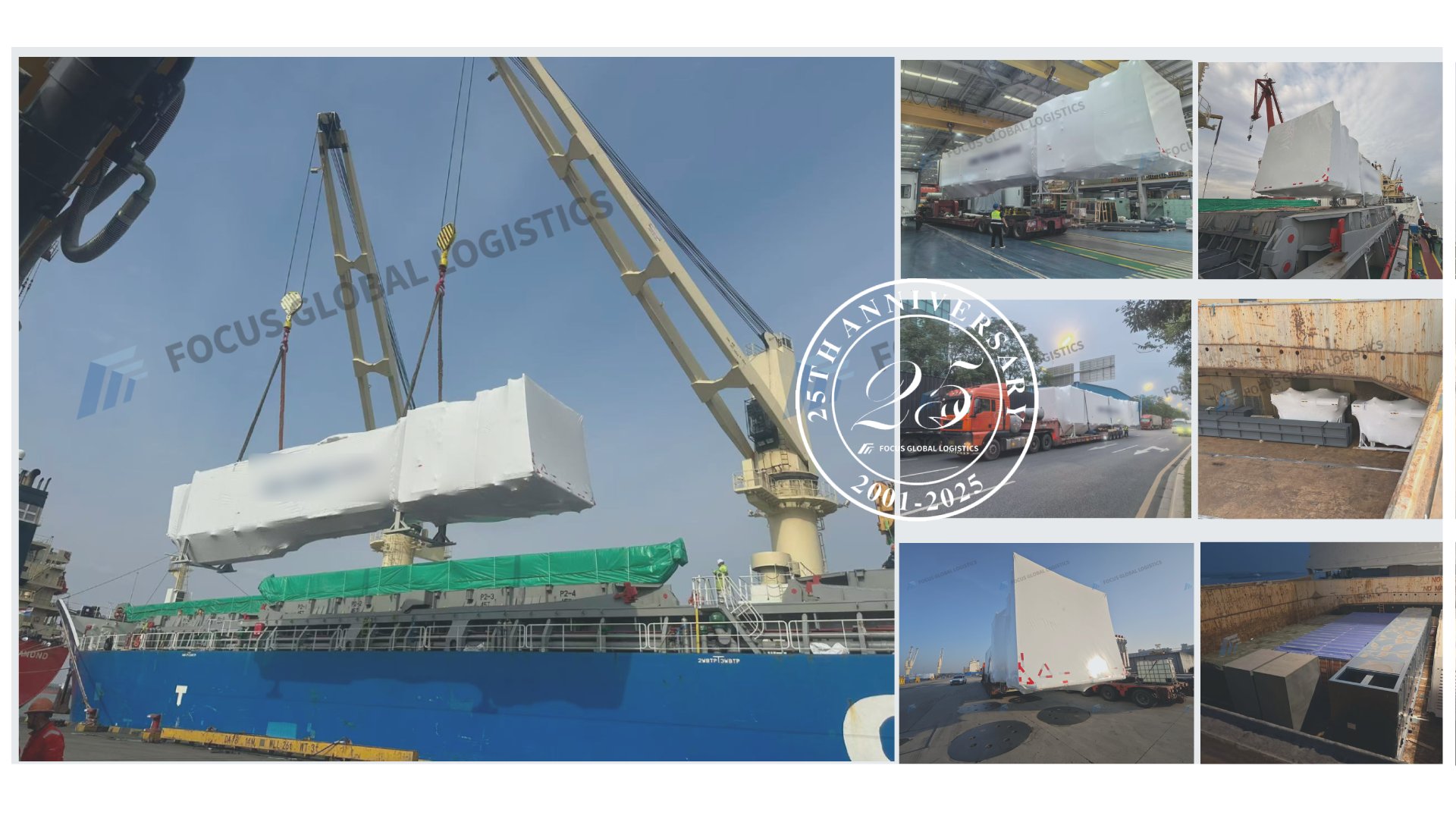
The commodity, a vital piece of airport infrastructure, presented a multifaceted logistical puzzle from the outset. With dimensions totaling 839 Cubic Meters (CBM) and a scheduled transit time (T/T) of 30 days via ocean freight, the project’s complexity was inherent. The PBB’s status as both non-stackable and OOG cargo fundamentally ruled out standard containerized shipping, necessitating specialized flat-rack or platform stowage. Furthermore, its delicate, asymmetrical structure and high center of gravity imposed strict handling and securing protocols, amplifying the challenge at every node of the supply chain.
Deconstructing the Triple-Threat Challenge
The project’s success was forged against a backdrop of three converging high-pressure challenges that threatened to derail timelines and inflate costs.
1. The Precarious Port Arrival Window: A Race Against the Vessel’s Clock
In ideal scenarios, oversized equipment arrives at the port of loading well in advance of the vessel’s berthing. This buffer allows for systematic customs clearance, thorough terminal inspections, and meticulous stowage planning. In this instance, a critical path overlap occurred: the cargo’s arrival at Zhangjiagang port commenced “only after” the designated carrier vessel had arrived and berthed. This compressed the entire port-side window—encompassing offloading from road transport, customs clearance, and the physical loading operation—into an intensely limited timeframe. The risk was severe: any delay in this sequential cascade would force the vessel to wait at berth, incurring substantial detention fees per day and potentially disrupting the entire liner schedule for the shipping line.
2. The Intricate Puzzle of Non-Stackable Stowage
The physical nature of the Passenger Boarding Bridge dictated a unique set of loading constraints. Its irregular shape and sensitivity to point-load pressure made it completely non-stackable. This presented a direct challenge to vessel planning. Ship owners and stevedores could not utilize vertical space efficiently; the bridge required prime, reserved space, typically on the open deck or as the top layer in a hold. Planning involved precise calculations to allocate a footprint that accounted for the cargo’s dimensions, center of gravity, and mandatory safety clearances from other cargo and ship structures. Any last-minute change in the cargo’s arrival sequence or condition could invalidate the pre-approved stowage plan, leading to costly re-planning and delays.
3. The Symphony of Multi-Stage, Simultaneous Execution
The narrow timeline demanded perfect synchronization of parallel processes typically conducted in sequence. This included:
Long-Haul Heavy Haulage: Coordinating a specialized truck convoy to transport the disassembled major components from the manufacturing facility in Shenzhen to the port in Zhangjiagang, navigating domestic regulations and road constraints.
Port Reception & staging: The ground team at Zhangjiagang needed to be prepared to receive, conduct immediate visual and documentary inspections, and safely position the components in a congested terminal area—all without the luxury of extended parking.
Accelerated Customs Clearance: The customs brokerage team had to ensure all documentation was flawless and processed through a condensed “just-in-time” clearance protocol, eliminating any risk of administrative hold at the most critical juncture.
The Focus Global Logistics Solution: Orchestrated Precision Through Proactive Strategy
Confronted with this triad of challenges, our dedicated Special Cargo Transportation Unit deployed a holistic strategy built on proactive communication, scenario planning, and operational flexibility.
Solution 1: Dynamic Stowage Planning & Collaborative Partnership with the Carrier
Understanding the stowage dilemma, we transformed the client-vessel operator relationship into a collaborative partnership.
Action: We initiated daily communication with the ship owner’s operations team weeks before the vessel’s arrival. We supplied exhaustive technical dossiers, including 3D models, detailed weight distribution maps, center-of-gravity analyses, and high-resolution photographs of every load-bearing point and protrusion.
Outcome: This transparency enabled the creation of a “Dynamic Stowage” plan. Instead of a single, rigid plan, we developed multiple loading scenarios (Plans A, B, and C). The final selection was made dynamically based on the actual arrival sequence of components at the terminal and real-time space availability. Our demonstrated professionalism and detailed contingency planning persuaded the carrier to grant a critical, pre-negotiated grace period within their schedule, ensuring their stevedore resources were on standby.
Solution 2: Military-Grade Synchronization for Port-Side Operations
To master the simultaneous operations, we implemented a mission-control style coordination.
Action A (Precise Fleet Management): We constant communication with all trucking teams, creating a staggered arrival schedule to prevent terminal gate congestion and allow for orderly offloading.
Action B (Advanced Customs Integration): We leveraged “pre-declaration” regulatory provisions. All documentation was submitted and preliminarily reviewed by customs authorities while the cargo was in transit. This meant the electronic release signal was virtually ready to be triggered the moment the physical cargo arrived and passed its brief inspection, turning a process that often takes days into one completed in hours.
Solution 3: Engineering for Cargo Integrity
Addressing the fragility of the cargo, we moved beyond standard lashing.
Action: Our engineering team designed and fabricated customized cribbing blocks and adaptive padding sets tailored to the exact contours and support points of the boarding bridge’s main chassis and key components. This ensured that when placed on the sometimes-uneven terminal apron or ship deck, the weight was distributed evenly, preventing dangerous structural torque or localized stress fractures during the critical load-bearing phases.
Demonstrated Outcomes and Core Competency Validation
The execution was a resounding success, measured by three key performance indicators:
1. Seamless Port Integration: All components were received, cleared, and assembled for loading in a flawlessly coordinated sequence immediately following the vessel’s berthing. The terminal operation resembled a precisely timed relay race.
2. Zero Vessel Delay: The carrier vessel experienced no additional port stay attributable to our cargo operations. It departed Zhangjiagang on schedule, preserving the integrity of its global itinerary and avoiding any cost penalties for our client.
3. Perfect Cargo Condition: The Passenger Boarding Bridge was loaded and secured without a single incident of physical damage, cosmetic scratch, or safety violation. It arrived in Manzanillo in the exact condition it left the factory.
Conclusion
This project transcends a simple freight movement; it is a case study in integrated project management for complex logistics. It highlights Focus Global Logistics’ core capability to not merely transport, but to orchestrate. Our strength lies in leveraging deep experience to perform anticipatory risk mitigation, foster proactive communication that unites all supply chain actors—shipper, carrier, terminal, and authorities—into a single, goal-oriented team, and engineer physical solutions for unique cargo needs. We are committed to refining this model of excellence, ready to deliver reliable, innovative, and efficient solutions for the world’s most challenging large-scale project shipments.
About Focus Global Logistics
Established in 2001, Shenzhen Focus Global Logistics Corporation (FGL), an integrated international logistics service provider has established 10 branches domestically, including Tianjin, Qingdao, Shanghai, Ningbo, Jiangmen, Guangzhou, Huizhou, Foshan, and Xi’an. This network covers East China, Central China, South China, and Middle China and forms a large net that includes the major ports of sea freight, air freight, and sea-land combined multimodal transportation from China to Southeast Asia, Southeast Asian Subcontinent, Africa, the Middle East, Central Asia and Europe.
With a specialized division dedicated to project cargo, heavy lift, BBK, and OOG shipments, we combine global network reach with localized expertise to deliver tailored solutions for industries including aerospace, infrastructure, energy, and manufacturing.
Post time: Jan-09-2026


