February 28, 2026
FGL has successfully completed a high-stakes project involving the shipment of a large batch of a famous brand heavy trucks from Shandong Province, China, to Jakarta, Indonesia. The operation tested the limits of logistical coordination, requiring the synchronization of multiple ground teams, tight vessel scheduling, and expedited customs clearance.
The scope of the project involved shipping 75 packages of heavy trucks, totaling a massive 542.6 metric tons and occupying 5,147.58 cubic meters. The cargo was transported via ocean freight from the Port of Qingdao (POL) to the Port of Jakarta (POD), with a transit time of just 12 days.
Transportation: Ocean
POL: Qingdao, China
POD: Jakarta, Indonesia
Commodity: Heavy Trucks
Freight Ton: 75PKG/542.6MT/5147.58CBM
T/T: 12 Days
Time: 28th, Feb, 2026
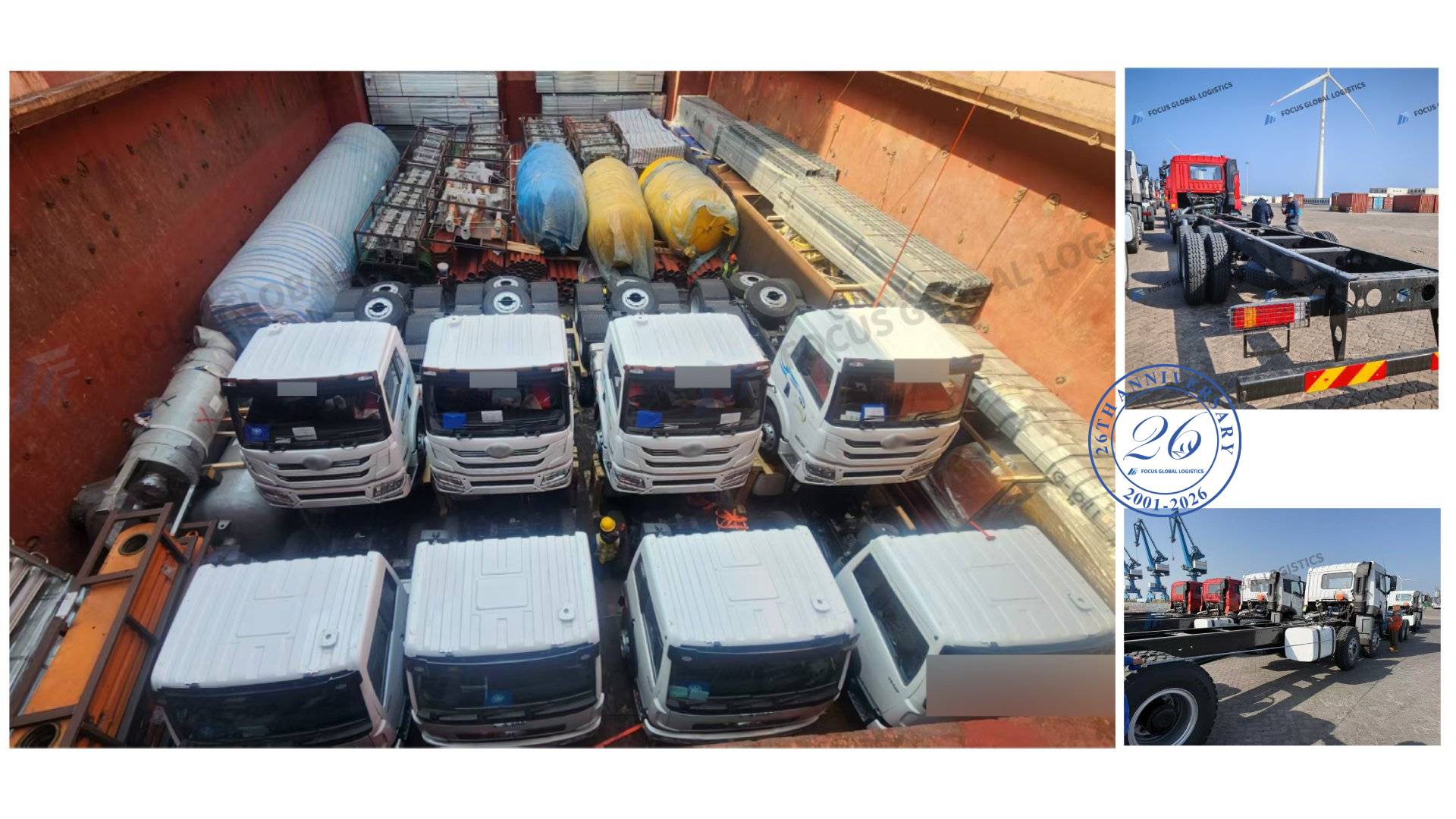
Navigating a Logistical Minefield
The project was deemed “high challenge” from the outset due to two primary obstacles that threatened to derail the tight schedule and incur significant costs.
1. The “Just-in-Time” Port Arrival Risk:
The most critical pain point was the extreme overlap between the cargo’s arrival at the port and the vessel’s berthing. In standard heavy-lift operations, cargo arrives days or even weeks in advance to allow for customs processing and terminal staging. In this instance, the cargo trucks only began arriving at the Qingdao port after the vessel had already berthed. This compressed the operational window to an absolute minimum, creating a significant risk: any delay in arrival or customs clearance would have forced the vessel to wait, leading to exorbitant detention and demurrage fees.
2. Multi-Stage Collaboration Under Intense Pressure:
The condensed timeline placed immense pressure on all parties involved. The complexity was further compounded by several factors:
Decentralized Pickup: A fleet of vehicles needed to be transported from various points to Qingdao and then to another city for pre-shipment procedures.
On-the-Ground Coordination: FGL had to work in lockstep with the client’s ground team to receive, inspect, and arrange temporary parking for the incoming trucks while awaiting final customs clearance.
Last-Minute Documentation Issues: The project was further challenged when it was discovered that some vehicles were missing their nameplates, requiring additional personnel to be deployed to rectify the problem on-site.
FGL’s Proactive and Agile Solution
To overcome these formidable challenges, FGL’s Qingdao team implemented a multi-pronged strategy centered on proactive communication, meticulous planning, and flexible execution.
1. “Dynamic Stowage” Collaboration with the Carrier:
Understanding the criticality of the timing, FGL established a pre-arrival communication protocol with the shipping line.
Action: Days before the vessel’s arrival, FGL provided the carrier with detailed technical specifications for every vehicle, including dimensions, weight, center of gravity, and loading diagrams.
Outcome: This transparency allowed the carrier to agree to a flexible stowage plan. Instead of a fixed loading sequence, multiple schemes (Plans A, B, and C) were pre-planned. This allowed for loading to commence based on the actual real-time arrival of the trucks at the terminal, effectively allowing customs clearance and port operations to run in parallel with the vessel’s loading process.
2. Precision Fleet and Customs Synchronization:
To ensure the physical flow of trucks matched the administrative flow of paperwork, FGL implemented two key actions:
Precision Fleet Dispatching: By meticulously estimating and communicating arrival times, the FGL team prevented bottlenecks caused by trucks arriving simultaneously, ensuring a steady and manageable flow into the port.
Advance Customs Integration: All customs documentation was reviewed and submitted electronically while the goods were still en route to the port. By utilizing an “advance declaration” model, FGL ensured that customs clearance was nearly instantaneous upon the cargo’s arrival, eliminating any administrative hold-ups.
A Flawless Execution
Through this combination of strategic foresight and on-the-ground agility, FGL achieved a seamless outcome:
Zero Waiting Time: The vessel did not incur any waiting time or detention fees, adhering perfectly to its departure schedule.
Zero Cargo Damage: Despite the rapid pace of operations, all 75 units were loaded with care, sustaining no damage.
Seamless Integration: All vehicles were safely, orderly, and efficiently assembled at the port and loaded onto the vessel within the extremely narrow window following the ship’s berthing.
“This project was a textbook example of modern project logistics,” said a spokesperson for the FGL Qingdao team. “It goes beyond simply moving cargo from A to B. It’s about project management, emergency response, and the ability to lead. By proactively integrating the carrier, the terminal, customs, and the client into a single, highly efficient temporary team, we turned an impossible timeline into a successful delivery.”
The success of this shipment underscores FGL’s core competency in special cargo transportation and its commitment to providing reliable, innovative solutions for the world’s most demanding large-scale projects.
About FGL:Established in 2001, Shenzhen Focus Global Logistics Corporation (FGL) is an integrated international logistics service provider, specializing in complex project cargo, heavy lift transport, and supply chain management. With 10 China branches, including Tianjin, Qingdao, Shanghai, Ningbo, Jiangmen, Guangzhou, Huizhou, Foshan, and Xi’an. FGL’s service network covers East China, Central China, South China, and Middle China and forms a large net that includes the major ports of sea freight, air freight, and sea-land combined multimodal transportation from China to Southeast Asia, Southeast Asian Subcontinent, Africa, the Middle East, Central Asia and Europe.
Post time: Mar-02-2026


